The 7 donor signals your CRM is tracking but never shows you
You already know your donors. That's not the gap.
The gap is between what you know and what's accessible to you at the moment you need it. Before a call. Before an ask. Before a conversation that's been three months in the making.
Your CRM is logging everything — every gift, every interaction, every event attendance. The data is there. What it wasn't built to do is synthesize that data into a coherent picture of a specific relationship, in the time you actually have, before the call you're making this afternoon.
Here are seven patterns that consistently predict major gift outcomes, and that live in the data you're already capturing.
1. Engagement recency
You know recency matters. The challenge is that surfacing it, quickly, across a portfolio of 200 relationships requires either a well-built report you run consistently or a system that surfaces it for you. When the infrastructure isn't there, recency tends to be tracked by memory rather than data.
For major donors, a recency gap of over 60 days without a personal interaction is worth noting. Not because something is necessarily wrong, but because it's the kind of thing worth knowing before you pick up the phone.
2. Relationship depth beyond giving history
Giving history is the most visible part of a donor record. Relationship depth, who introduced them, who else at your organization knows them, how embedded they are in your mission community tends to live in people's heads rather than the CRM.
The risk is that the relationship depth that exists only in memory doesn't transfer when a gift officer leaves. Mapping it formally for major donors is a one-time investment that protects the relationship regardless of what changes on your team.
3. Giving pattern deviation
Donors develop rhythms. A consistent December donor, a specific designation that's never varied, a gift size that's grown steadily for five years. These patterns are meaningful when they hold, and worth a conversation when they shift.
A deviation isn't a warning sign, it's a data point. A 40% reduction in gift size might mean financial headwinds, a shift in priorities, or a conversation that didn't land the way you'd hoped. The value is in knowing it happened so you can find out why, rather than discovering it on a LYBUNT report six months later.
4. Behavioral engagement trajectory
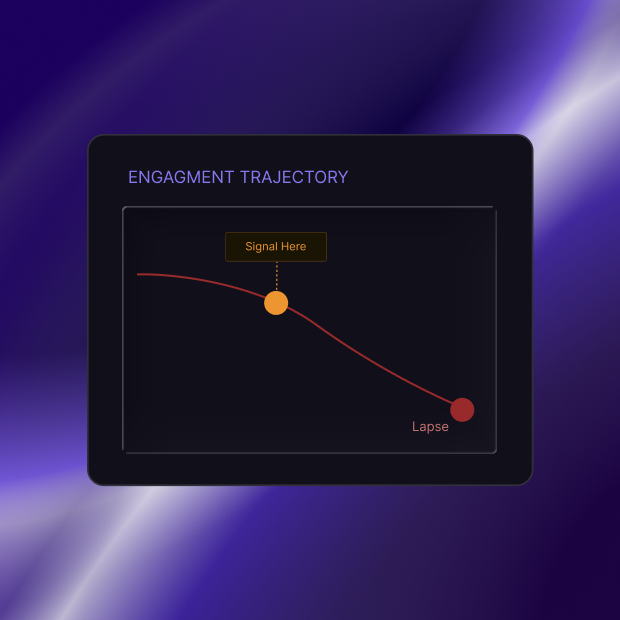
Giving behavior tends to follow behavioral engagement by several months. A donor who's been consistently attending events, opening emails, and volunteering, and has started doing less of those things, may still be giving. But the trajectory is telling you something before the giving data catches up.
Tracking engagement breadth, not just recency, gives you an earlier signal. One point for each engagement type active in the past 12 months: giving, events, volunteering, and communications response. The trend across those four is often more predictive than any one of them individually.
5. Communication response patterns
There's a difference between logging that a call was made and noting how the conversation actually went. Response time to personal outreach, energy level in the exchange, and whether the donor initiated contact, are relationship health indicators that get lost when logging is treated as a checkbox rather than a record.
The teams that surface this well have built a culture of qualitative logging: not just "called on Thursday" but "called on Thursday, shorter than usual, seemed distracted, mentioned they're in the middle of a board transition."
6. Capacity and life stage indicators
A donor's capacity and context change over time, and the information is often publicly available. A business sale, a retirement, a board appointment at another organization, these are signals that your existing relationship might be ready for a different kind of conversation.
Building a light-touch annual review of capacity indicators for major donors, public news, LinkedIn, and what you hear through your own network keeps your understanding of each relationship current in ways that CRM data alone can't.
7. Mission alignment signals
This one requires the most interpretation. Donors give to causes that connect to their identity, to who they're becoming, and what they want to stand for. When that alignment shifts, giving eventually follows.
Alignment shifts show up in data: a move from unrestricted to restricted giving, interest narrowing to one program, and more specific questions about how gifts are used. These aren't complaints, they're often an invitation to a deeper conversation about impact. The gift officers who hear them as signals rather than noise tend to have very different retention outcomes.
The common thread
None of these signals requires data you don't already have. They require a system that surfaces them before you need them, rather than requiring you to go looking after the fact.
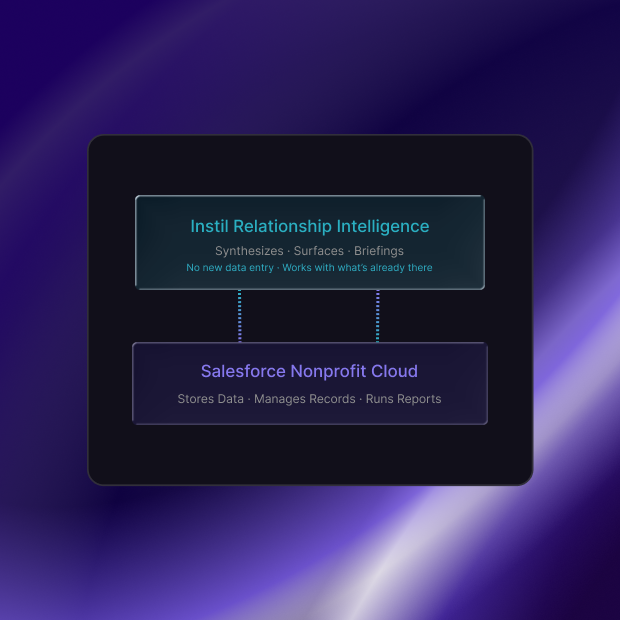
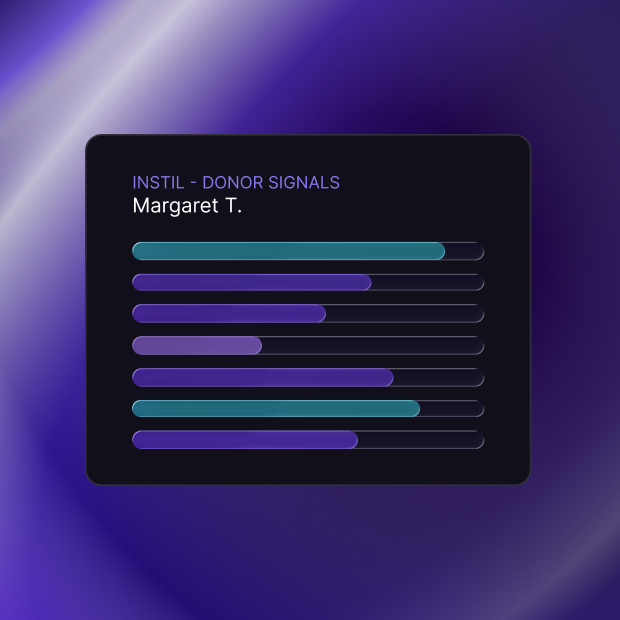
Relationship intelligence platforms like Instil generate a pre-call briefing from the data already in Salesforce or Blackbaud so the signal is in front of you before the call, not assembled from memory during it.
Want to see what these signals look like? We show major gifts teams on Salesforce what this looks like in practice, in 20 minutes.