Salesforce for major gifts: what it does well and where teams often need more
Salesforce Nonprofit Cloud is the most widely deployed CRM in enterprise major gifts fundraising, and for good reason. The data architecture is genuinely strong, the reporting capabilities are extensive, and the integration ecosystem connects to almost everything a development operation needs.
It's also, if you talk to gift officers who use it daily, frequently not the thing they reach for in the hour before a significant donor call.
Understanding that gap between what Salesforce does well as infrastructure and what the pre-call moment actually requires is useful for any team trying to get more from the investment they've already made.
What Salesforce does well
Data architecture and storage
Salesforce's data model is built to capture the full complexity of constituent relationships. Gifts, interactions, relationships, campaign responses, and event attendance are structured and queryable across the entire history of your engagement. Organizations that have invested in building out their Salesforce instance well have an asset that genuinely supports serious portfolio work.
Reporting and portfolio analytics
For development directors and analytics professionals, Salesforce's reporting capabilities are extensive. Portfolio-level retention cohorts, giving trends, campaign performance, segment analysis, the infrastructure is there, and it produces real insight when the underlying data is clean.
Workflow and task management
Salesforce's activity and task management, used consistently, creates portfolio visibility across a team. Who touched which donor and when? What follow-ups are pending? Where the pipeline sits. These are genuine operational capabilities.
Integration ecosystem
Salesforce connects to almost everything: payment processors, email platforms, event tools, and wealth screening vendors. For complex development operations, the integration surface is one of its strongest attributes.
Where gift officers often find friction
Pre-call preparation
The consistent friction point for major gifts professionals using Salesforce is the pre-call assembly problem. A gift officer preparing for a significant donor conversation might navigate through a giving history record, scroll through an activity log, cross-reference event attendance, recall who else on the team has a relationship with this person, and try to remember what was said last time. None of that lives in one place.
Salesforce was built to store and query relationship data, not to synthesize it into a pre-call picture. That synthesis has always been the gift officer's job. The question is how much time it takes.
Signal surfacing
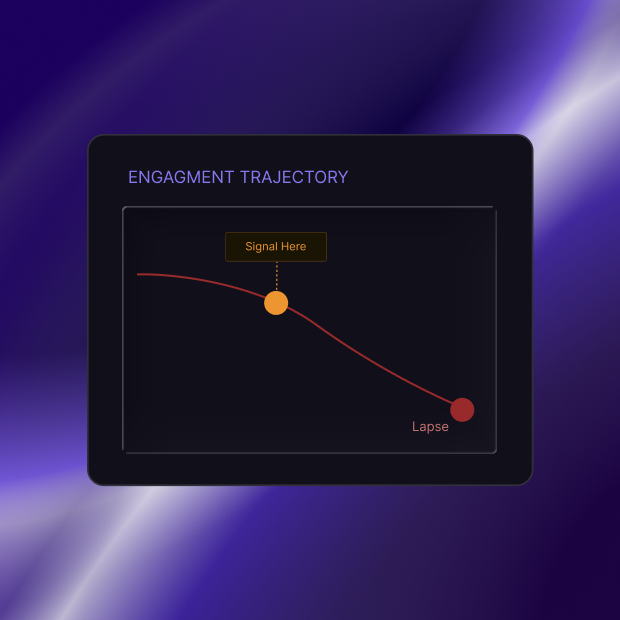
Salesforce logs relationship activity extremely well. What it doesn't do on its own is surface patterns across that activity as actionable signals. A donor whose engagement has been gradually softening over six months, with fewer events, slower responses, and slightly smaller giving, has left a trail in the CRM. But nothing in the system flags that trail as a pattern worth noting before the next call.
Surfacing those signals requires either consistent manual reporting. building and running the right views on a regular cadence, or a tool that does it automatically.
Mobile experience for field work
Salesforce's mobile experience has improved steadily, but it remains better suited to desk-based data entry and reporting than to quick relationship context lookup in the field. For gift officers accessing notes from their phone between meetings, the experience can feel like it slows them down rather than helping them.
What teams do about it
Teams that have been on Salesforce for years have generally built workarounds for the pre-call friction: personal notes apps, saved report views they run religiously before meetings, and team practices around logging that make the most important context findable quickly.
Those workarounds work. They also live in the gift officer rather than the system, which means they don't always transfer when the team changes.
Where relationship intelligence fits
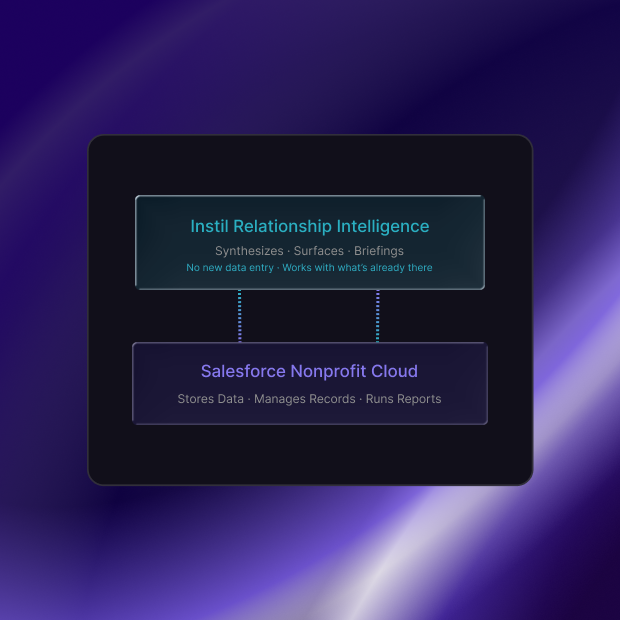
Instil isn't a Salesforce replacement. It's a relationship intelligence layer built on top of Salesforce (and Blackbaud), one that synthesizes the data already there and surfaces it before calls, as a pre-call briefing, with the context assembled rather than scattered across records.
The data stays in Salesforce. The CRM investment stays intact. What changes is the amount of time required to go from "I have a call in an hour" to "I know exactly what I need to know before this conversation."
If your team is on Salesforce Nonprofit Cloud and wants to see what relationship intelligence looks like on your data, we do 20-minute demos, no pitch, just the product.