The real reason major donors lapse, and what the data usually shows ahead of time
When a major donor goes quiet, the instinct is often to look for an external cause. Financial reversal. Shifting priorities. A competitor organization that made the right ask at the right moment. These things happen, and they're real.
They're also, in the data, usually not the primary story.
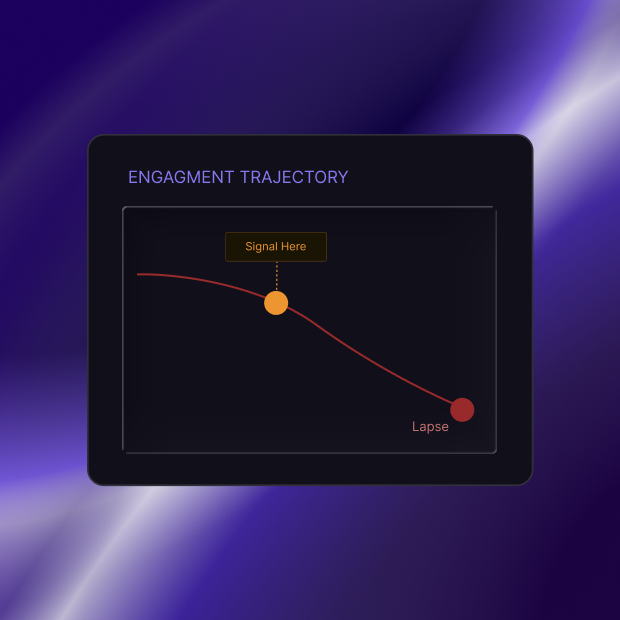
The more common pattern visible in retrospect across most major donor lapses, is a gradual softening of the relationship that predated the lapse by months. The signals were in the CRM. They just weren't surfaced as a picture of where things were heading.
What a lapse usually looks like in the data before it happens
Major donor lapse almost never arrives without warning. It accumulates through small disconnections that compound over time without intervention.
The pattern is almost always recognizable after the fact: a donor who attended your signature event consistently skips one year. Response time to personal outreach lengthens. A gift that had been growing levels off or comes in slightly smaller. A scheduled interaction gets pushed back and then doesn't happen. Twelve months later, the donor is on the LYBUNT report.
At each stage of that sequence, there was a signal. And at each stage, the question is whether the relationship infrastructure was in place to surface it.
Why external explanations are often incomplete
It's worth sitting with the data on this. Donors who experience significant financial setbacks don't uniformly lapse from organizations where the relationship is strong. They often communicate. They reduce rather than eliminate. They stay engaged because the identity connection to the mission is still active.
The donors who disappear quietly without a conversation, without a transition, are more often the ones where the relationship had become thinner than it appeared in the giving record. Where the interaction was consistent enough to look healthy, but the genuine connection had been eroding underneath it.
That's not a failure of the gift officer's ability or care. It's what happens when a portfolio is large enough that the depth of each relationship can't be held in active awareness at all times without support.
The identity alignment thread
One of the clearest patterns in major donor retention is the role of identity. Donors give to causes that connect to who they want to be, causes where their giving reinforces a meaningful sense of self. When that connection weakens, the giving often follows, eventually.
The weakening shows up in data before it shows up in giving: restricted designations that narrow over time, less enthusiastic response to impact updates, and more transactional interactions where there used to be genuine conversation. These aren't complaints or demands, they're often signals of a relationship that wants to go somewhere different, and hasn't been invited to.
The gift officers who notice these signals early tend to have a very different kind of conversation than the ones who discover them on a retention report. A conversation that starts "I've noticed your giving has been more specifically directed this year. I'd love to understand what's exciting you most about our work right now" is a relationship conversation. The same conversation initiated after a lapse is a reactivation ask.
What changes when signals surface earlier
The shift from lagging to leading indicator work in major gifts doesn't require perfect information or perfect systems. It requires a consistent practice of checking the signals that are already in the CRM recency, giving pattern, engagement breadth, and relationship depth before they become patterns that are harder to reverse.
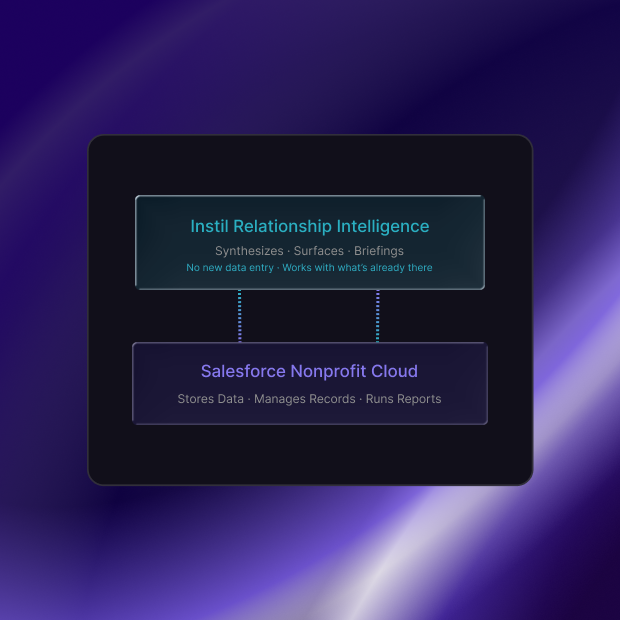
For teams with clean data and the right reporting infrastructure, this is achievable with Salesforce or Blackbaud directly. For teams where the reporting isn't built or the time isn't there, relationship intelligence platforms like Instil surface these patterns automatically as a briefing before each interaction, not as a report run after something changes.
The goal in either case is the same: to have the relationship conversation while the relationship is warm, not while you're trying to revive it.
Want to see what an early signal looks like in practice? We show major gifts teams on Salesforce and Blackbaud what relationship intelligence surfaces in 20 minutes.